


Successful creative work thrives on collaboration. Some of the best ideas emerge in spaces between working ones. Impromptu brainstorms or tapping someone on the shoulder at their desk create opportunities to really dig deep into an idea.
But what happens when you go from having those opportunities in person to becoming a fully remote company? When we decided to become a fully remote agency, the biggest question wasn’t logistics; it was how to continue being creative without losing our spark. How do you preserve (and ideally improve) the creative quality and cohesion of the team when you remove physical proximity?
That’s the question we set out to solve.
The Core Problem Remote Work Introduces
Remote work doesn’t eliminate creativity completely, but it does create a more challenging collaboration environment. Feedback must become intentional when working with a remote team. Without intentionality, teams can drift into silos that cause miscommunication and create walls.
As a team, feedback and collaboration are integral to our workflow. We want all relevant team members’ voices to be heard on major projects. When we first went fully remote, it was a difficult transition for team members who weren’t already fully remote. But with the right system, we started to find our groove.
How We Made Remote Creative Work Work
Remote creative work doesn’t struggle because people are apart; it struggles when collaboration and feedback have no structure.
In the office, structure happens accidentally. Remote work requires you to build it intentionally. So instead of focusing on “replicating the office,” we started designing a system that supports how creative work gets made: collaboratively, iteratively and with multiple moments for ideas to evolve.
Our Remote Creative System
What we landed on is less a set of tools and more a series of creative processes and touchpoints that keep everyone aligned and moving in the same direction.
Here’s what that looks like:
1. Official Kickoff (Shared Context + Intent)
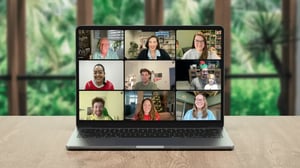
Every project starts with a full-team Zoom kickoff. The goal is to: give context, clarify objectives and level-set expectations so no one is left guessing on the details.
Remote work tends to remove context, so we had to put it back purposefully. Having an official kickoff creates shared understanding between everyone.
2. Constant sharing of concepts and work
Once work begins, we try to keep a steady stream of updates flowing through Slack. This includes sharing screenshots, mockups of designs or copy, and things that inspired us throughout the project. This helps everyone stay in sync and opens up opportunities for feedback and collaboration.
In the office, these moments are more natural and a normal part of your day. Remotely, if you don’t update your team or intentionally create these opportunities, you can easily become isolated, and your work will suffer.
3. Internal Review Meeting
Once concepts take shape, we regroup on Zoom to share work-in-progress and walk through where the creative is headed. This gives the team space to challenge ideas and adjust while everything is still flexible.
From there, we may run a mock presentation if needed. It’s our chance to stress-test how we’ll present our work and see how it holds up when presented.
Most importantly, this is where we get the feedback that sharpens the work. The internal review exists to present the ideas and pressure-test them. Getting feedback from leadership and the rest of the team is integral to a great final product.
4. Handoffs and Knowledge Sharing
Throughout the process, we keep handoffs, notes and progress updates transparent. If someone is blocked, traveling or slammed, another teammate can pick up where they left off without starting from zero. Once one team member finishes their piece, they’ll have all the information they need to pick up where needed.
Remote work requires continuity. Knowledge sharing keeps momentum high and eliminates bottlenecks that can derail timelines.
Final Thoughts
Remote work forced us to rethink how we work and collaborate. In the end, it made the work more intentional and aligned. If you’re worried about losing your team’s creative spark by going fully remote, remember to be intentional. Create systems and touchpoints to keep everyone on your team aligned.